

How To Repair A Cracked Toilet Flanges

Plumbing is whatsoever arrangement that conveys fluids for a wide range of applications. Plumbing uses pipes, valves, plumbing fixtures, tanks, and other apparatuses to convey fluids.[i] Heating and cooling (HVAC), waste removal, and beverage water delivery are among the most common uses for plumbing, but information technology is not limited to these applications.[2] The word derives from the Latin for pb, plumbum, every bit the offset effective pipes used in the Roman era were lead pipes.[3]
In the developed earth, plumbing infrastructure is disquisitional to public health and sanitation.[4] [5]
Boilermakers and pipefitters are not plumbers although they work with piping as role of their trade and their work can include some plumbing.
History

Plumbing originated during aboriginal civilizations, as they developed public baths and needed to provide beverage water and wastewater removal for larger numbers of people.[vi]
The Mesopotamians introduced the earth to dirt sewer pipes effectually 4000 BCE, with the earliest examples found in the Temple of Bel at Nippur and at Eshnunna,[seven] used to remove wastewater from sites, and capture rainwater, in wells. The city of Uruk contains the oldest known examples of brick constructed Latrines, constructed atop interconnecting fired dirt sewer pipes, c.3200 BCE.[8] [nine] Clay pipes were later used in the Hittite city of Hattusa.[ten] They had easily detachable and replaceable segments, and immune for cleaning.
Standardized earthen plumbing pipes with broad flanges making apply of asphalt for preventing leakages appeared in the urban settlements of the Indus Valley Civilization by 2700 BC.[eleven]
Copper pipage appeared in Arab republic of egypt by 2400 BCE, with the Pyramid of Sahure and bordering temple circuitous at Abusir, found to be connected by a copper waste pipe.[12]
The word "plumber" dates from the Roman Empire.[13] The Latin for pb is plumbum . Roman roofs used lead in conduits and bleed pipes[xiv] and some were besides covered with atomic number 82. Lead was likewise used for piping and for making baths.[15]
Plumbing reached its early apex in ancient Rome, which saw the introduction of expansive systems of aqueducts, tile wastewater removal, and widespread apply of pb pipes. The Romans used lead pipe inscriptions to forbid water theft. With the Fall of Rome both water supply and sanitation stagnated—or regressed—for well over 1,000 years. Improvement was very slow, with footling effective progress fabricated until the growth of modernistic densely populated cities in the 1800s. During this period, public wellness government began pressing for better waste disposal systems to be installed, to forestall or control epidemics of disease. Earlier, the waste matter disposal system had consisted of collecting waste matter and dumping it on the basis or into a river. Somewhen the evolution of split up, hugger-mugger water and sewage systems eliminated open sewage ditches and cesspools.
In postal service-classical Kilwa The wealthy enjoyed indoor plumbing in their stone homes.[xvi] [17]
Almost large cities today pipe solid wastes to sewage treatment plants in social club to separate and partially purify the water, earlier emptying into streams or other bodies of h2o. For drink water use, galvanized iron pipe was commonplace in the United States from the tardily 1800s until around 1960. Afterward that period, copper piping took over, beginning soft copper with flared fittings, then with rigid copper tubing using soldered fittings.
The apply of lead for potable h2o declined sharply after Globe War 2 because of increased awareness of the dangers of lead poisoning. At this time, copper piping was introduced equally a better and safer alternative to lead pipes.[xviii]
Systems
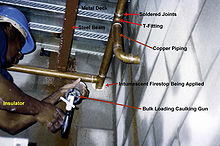
Copper piping system in a building
The major categories of plumbing systems or subsystems are:[19]
- potable cold and hot tap water supply
- plumbing drainage venting
- sewage systems and septic systems with or without hot water heat recycling and graywater recovery and treatment systems
- Rainwater, surface, and subsurface water drainage
- fuel gas piping
- hydronics, i.e. heating and cooling systems using water to transport thermal energy, as in district heating systems, like for example the New York City steam system.
Water pipes

A h2o pipe is a pipe or tube, often made of plastic or metal,[a] that carries pressurized and treated fresh water to a edifice (equally part of a municipal water system), as well equally inside the building.
History
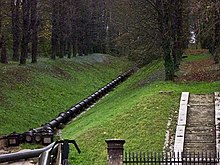
Lead was the favoured textile for h2o pipes for many centuries because its malleability made it applied to work into the desired shape. Such utilize was and so common that the discussion "plumbing" derives from plumbum, the Latin discussion for lead. This was a source of lead-related health problems in the years earlier the wellness hazards of ingesting atomic number 82 were fully understood; among these were stillbirths and loftier rates of infant mortality. Lead h2o pipes were still widely used in the early 20th century and remain in many households. Lead-tin blend solder was usually used to join copper pipes, only modern practice uses tin can-antimony alloy solder instead in society to eliminate lead hazards.[xx]
Despite the Romans' common utilize of lead pipes, their aqueducts rarely poisoned people. Dissimilar other parts of the globe where lead pipes cause poisoning, the Roman h2o had so much calcium in it that a layer of plaque prevented the water contacting the pb itself. What often causes defoliation is the large amount of prove of widespread lead poisoning, peculiarly amongst those who would take had easy access to piped water,[21] an unfortunate result of atomic number 82 beingness used in cookware and as an condiment to processed food and drink (for example as a preservative in vino).[22] Roman pb pipe inscriptions provided information on the owner to prevent water theft.
Wooden pipes were used in London and elsewhere during the 16th and 17th centuries. The pipes were hollowed-out logs which were tapered at the end with a small-scale hole in which the h2o would pass through.[23] The multiple pipes were and then sealed together with hot fauna fat. Wooden pipes were used in Philadelphia,[24] Boston, and Montreal in the 1800s. Built-up wooden tubes were widely used in the Usa during the 20th century. These pipes (used in place of corrugated atomic number 26 or reinforced concrete pipes) were made of sections cut from short lengths of forest. Locking of adjacent rings with hardwood dowel pins produced a flexible structure. About 100,000 feet of these wooden pipes were installed during WW2 in drainage culverts, storm sewers and conduits, under highways and at regular army camps, naval stations, airfields and ordnance plants.
Cast atomic number 26 and ductile iron pipe was long a lower-cost culling to copper before the advent of durable plastic materials only special non-conductive fittings must be used where transitions are to be fabricated to other metallic pipes (except for terminal fittings) in order to avoid corrosion attributable to electrochemical reactions between dissimilar metals (run across galvanic cell).[25]
Statuary fittings and short pipe segments are commonly used in combination with diverse materials.[26]
Difference between pipes and tubes

Typical PVC municipal water main existence installed in Ontario, Canada

A plastic water pipe being installed. Note that the inner tube is actually transporting the water, while the outer tube only serves as a protective casing
The difference between pipes and tubes is a affair of sizing. For instance, PVC pipe for plumbing applications and galvanized steel pipe are measured in iron pipe size (IPS). Copper tube, CPVC, PeX and other tubing is measured nominally, basically an average diameter. These sizing schemes allow for universal adaptation of transitional fittings. For instance, 1/2" PeX tubing is the same size as 1/two" copper tubing. ane/two" PVC on the other hand is not the same size every bit 1/2" tubing, and therefore requires either a threaded male person or female person adapter to connect them. When used in agricultural irrigation, the atypical grade "pipe" is often used every bit a plural.[27]
Pipe is bachelor in rigid joints, which come in various lengths depending on the material. Tubing, in particular copper, comes in rigid difficult tempered joints or soft tempered (annealed) rolls. PeX and CPVC tubing also comes in rigid joints or flexible rolls. The temper of the copper, whether it is a rigid joint or flexible curlicue, does not touch the sizing.[27]
The thicknesses of the water pipage and tube walls can vary. Because piping and tubing are commodities, having a greater wall thickness implies higher initial price. Thicker walled pipe by and large implies greater durability and higher pressure tolerances. Pipe wall thickness is denoted past various schedules or for large bore polyethylene pipe in the UK by the Standard Dimension Ratio (SDR), divers as the ratio of the pipe diameter to its wall thickness. Pipe wall thickness increases with schedule, and is available in schedules xx, xl, eighty, and higher in special cases. The schedule is largely determined by the operating pressure of the system, with higher pressures commanding greater thickness. Copper tubing is available in four wall thicknesses: type DWV (thinnest wall; but allowed every bit drain pipe per UPC), type '1000' (sparse; typically only allowed equally drain pipage by IPC code), type 'L' (thicker, standard duty for water lines and water service), and blazon 'K' (thickest, typically used cloak-and-dagger between the main and the meter).
Wall thickness does non affect pipe or tubing size.[28] 1/2" L copper has the same outer diameter as ane/2" K or M copper. The aforementioned applies to pipe schedules. As a result, a slight increment in pressure losses is realized due to a decrease in flowpath every bit wall thickness is increased. In other words, 1 pes of 1/2" 50 copper has slightly less book than ane foot of 1/2 K copper.[ citation needed ]
Materials
Water systems of ancient times relied on gravity for the supply of water, using pipes or channels usually made of clay, lead, bamboo, wood, or stone. Hollowed wooden logs wrapped in steel banding were used for plumbing pipes, particularly h2o mains. Logs were used for water distribution in England close to 500 years ago. The states cities began using hollowed logs in the late 1700s through the 1800s. Today, near plumbing supply pipe is fabricated out of steel, copper, and plastic; near waste (also known as "soil")[29] out of steel, copper, plastic, and cast iron.[29]
The straight sections of plumbing systems are called "pipes" or "tubes". A piping is typically formed via casting or welding, whereas a tube is fabricated through extrusion. Pipage unremarkably has thicker walls and may exist threaded or welded, while tubing is thinner-walled and requires special joining techniques such as brazing, compression fitting, crimping, or for plastics, solvent welding. These joining techniques are discussed in more detail in the pipage and plumbing fittings article.
Steel
Galvanized steel potable h2o supply and distribution pipes are commonly found with nominal pipage sizes from three⁄8 inch (9.5 mm) to ii inches (51 mm). It is rarely used today for new structure residential plumbing. Steel piping has National Pipe Thread (NPT) standard tapered male person threads, which connect with female person tapered threads on elbows, tees, couplers, valves, and other fittings. Galvanized steel (often known simply as "galv" or "atomic number 26" in the plumbing merchandise) is relatively expensive, and hard to work with due to weight and requirement of a pipe threader. It remains in common use for repair of existing "galv" systems and to satisfy building code not-combustibility requirements typically found in hotels, flat buildings and other commercial applications. It is likewise extremely durable and resistant to mechanical abuse. Black lacquered steel pipe is the most widely used pipe textile for fire sprinklers and natural gas.
Most typical single family unit home systems won't crave supply piping larger than 3⁄4 inch (nineteen mm) due to expense as well as steel piping's tendency to become obstructed from internal rusting and mineral deposits forming on the inside of the pipage over time once the internal galvanizing zinc coating has degraded. In drink water distribution service, galvanized steel pipe has a service life of nearly 30 to 50 years, although it is not uncommon for it to exist less in geographic areas with corrosive water contaminants.
Copper
Copper pipage and tubing was widely used for domestic h2o systems in the latter half of the twentieth century. Demand for copper products has fallen due to the dramatic increase in the toll of copper, resulting in increased demand for alternative products including PEX and stainless steel.
Plastic
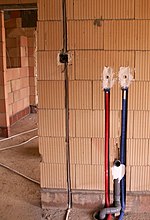
Plastic hot and common cold supply piping for a sink
Plastic pipe is in wide employ for domestic water supply and drain-waste-vent (DWV) pipe. Principal types include: Polyvinyl chloride (PVC) was produced experimentally in the 19th century but did non become practical to manufacture until 1926, when Waldo Semon of BF Goodrich Co. developed a method to plasticize PVC, making it easier to process. PVC pipe began to exist manufactured in the 1940s and was in broad utilize for Drain-Waste-Vent piping during the reconstruction of Federal republic of germany and Japan post-obit WWII. In the 1950s, plastics manufacturers in Western Europe and Japan began producing acrylonitrile butadiene styrene (ABS) pipage. The method for producing cross-linked polyethylene (PEX) was likewise developed in the 1950s. Plastic supply pipes have become increasingly common, with a variety of materials and fittings employed.
- PVC/CPVC – rigid plastic pipes similar to PVC drain pipes simply with thicker walls to bargain with municipal water force per unit area, introduced around 1970. PVC stands for polyvinyl chloride, and it has get a common replacement for metal pipe. PVC should exist used only for cold water, or for venting. CPVC tin be used for hot and cold beverage water supply. Connections are made with primers and solvent cements as required by code.[thirty]
- PP – The fabric is used primarily in housewares, food packaging, and clinical equipment,[31] but since the early 1970s has seen increasing use worldwide for both domestic hot and cold water. PP pipes are heat fused, being unsuitable for the use of glues, solvents, or mechanical fittings. PP pipe is often used in light-green edifice projects.[32]
- PBT – flexible (ordinarily gray or black) plastic pipe which is fastened to spinous fittings and secured in place with a copper crimp ring. The primary manufacturer of PBT tubing and fittings was driven into bankruptcy by a class-action lawsuit over failures of this system.[ citation needed ] However, PB and PBT tubing has since returned to the market and codes, typically first for "exposed locations" such as risers.
- PEX – cantankerous-linked polyethylene system with mechanically joined fittings employing barbs, and crimped steel or copper rings.
- Polytanks – plastic polyethylene cisterns, hush-hush water tanks, above basis water tanks, are ordinarily fabricated of linear polyethylene suitable as a beverage water storage tank, provided in white, black or green.
- Aqua – known as PEX-Al-PEX, for its PEX/aluminum sandwich, consisting of aluminum pipe sandwiched between layers of PEX, and connected with modified brass compression fittings. In 2005, many of these fittings were recalled.[ further explanation needed ]
Present-day water-supply systems use a network of high-pressure pumps, and pipes in buildings are now fabricated of copper,[33] brass, plastic (particularly cross-linked polyethylene called PEX, which is estimated to be used in 60% of single-family unit homes[34]), or other nontoxic material. Due to its toxicity, near cities moved abroad from atomic number 82 water-supply pipage past the 1920s in the United States,[35] although lead pipes were canonical by national plumbing codes into the 1980s,[36] and atomic number 82 was used in plumbing solder for drinking water until it was banned in 1986.[35] Drain and vent lines are made of plastic, steel, cast iron, or lead.[37] [38]
Gallery
-
A specific water piping made for use with force per unit area vessels. The pipe can sustain high pressure-water and is relatively small
-

Concrete h2o pipe
-
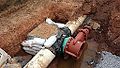
Connecting to an existing water line (white pipe) with a stainless steel borer sleeve and valve (crimson). A physical thrust block is being formed behind the new connectedness.
-
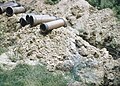
Sewer pipe
Components
In add-on to lengths of pipe or tubing, pipe fittings such as valves, elbows, tees, and unions. are used in plumbing systems.[39] Pipe and fittings are held in place with pipe hangers and strapping.
Plumbing fixtures are exchangeable devices that use water and can be connected to a building's plumbing organisation. They are considered to be "fixtures", in that they are semi-permanent parts of buildings, non usually owned or maintained separately. Plumbing fixtures are seen by and designed for the end-users. Some examples of fixtures include h2o closets[xl] (besides known as toilets), urinals, bidets, showers, bathtubs, utility and kitchen sinks, drinking fountains, water ice makers, humidifiers, air washers, fountains, and eye wash stations.
Sealants
Threaded pipe joints are sealed with thread seal record or pipe dope. Many plumbing fixtures are sealed to their mounting surfaces with plumber'south putty.[41]
Equipment and tools

A plumber tightening the fitting on a gas supply line.
Plumbing fixtures includes devices ofttimes behind walls or in utility spaces which are non seen by the general public. It includes h2o meters, pumps, expansion tanks, back period preventers, h2o filters, UV sterilization lights, h2o softeners, h2o heaters, heat exchangers, gauges, and control systems.
There are many tools a plumber needs to exercise a skilful plumbing job. While many simple plumbing tasks tin can be completed with a few mutual paw held tools, other more circuitous jobs require specialised tools, designed specifically to make the job easier.
Specialized plumbing tools include pipe wrenches, flaring pliers, pipage vise, pipage bending machine, pipe cutter, dies, and joining tools such as soldering torches and crimp tools. New tools take been developed to help plumbers fix problems more than efficiently. For example, plumbers apply video cameras for inspections of subconscious leaks or other issues; they likewise use hydro jets, and high force per unit area hydraulic pumps continued to steel cables for trench-less sewer line replacement.
Flooding from excessive rain or clogged sewers may require specialized equipment, such as a heavy duty pumper truck designed to vacuum raw sewage.[ citation needed ]
Problems
Leaner have been shown to live in "premises plumbing systems". The latter refers to the "pipes and fixtures inside a building that transport water to taps later it is delivered by the utility".[42] Community water systems take been known for centuries to spread waterborne diseases similar typhoid and cholera. However, "opportunistic premises plumbing pathogens" have been recognized only more recently: Legionella pneumophila, discovered in 1976, Mycobacterium avium, and Pseudomonas aeruginosa are the most commonly tracked bacteria, which people with depressed amnesty tin inhale or ingest and may become infected with.[43] Some of the locations where these opportunistic pathogens tin grow include faucets, shower heads, h2o heaters and along piping walls. Reasons that favor their growth are "loftier surface-to-volume ratio, intermittent stagnation, low disinfectant remainder, and warming cycles". A loftier surface-to-volume ratio, i.e. a relatively large surface expanse allows the bacteria to form a biofilm, which protects them from disinfection.[43]
Regulation

Much of the plumbing piece of work in populated areas is regulated past regime or quasi-regime agencies due to the direct bear on on the public's health, safety, and welfare. Plumbing installation and repair work on residences and other buildings generally must be washed according to plumbing and edifice codes to protect the inhabitants of the buildings and to ensure safe, quality construction to hereafter buyers. If permits are required for work, plumbing contractors typically secure them from the authorities on behalf of home or building owners.[ citation needed ]
Australia
In Commonwealth of australia, the national governing trunk for plumbing regulation is the Australian Building Codes Board. They are responsible for the cosmos of the National Construction Code (NCC), Volume 3 of which, the Plumbing Regulations 2008[44] and the Plumbing Code of Commonwealth of australia,[45] pertains to plumbing.
Each Regime at the state level has their own Say-so and regulations in place for licensing plumbers. They are too responsible for the interpretation, assistants and enforcement of the regulations outlined in the NCC.[46] These Regime are unremarkably established for the sole purpose of regulating plumbing activities in their respective states/territories. Still, several land level regulation acts are quite outdated, with some even so operating on local policies introduced more than than a decade ago. This has led to an increase in plumbing regulatory issues not covered under current policy, and as such, many policies are currently existence updated to cover these more modern issues. The updates include changed to the minimum feel and preparation requirements for licensing, additional work standards for new and more specific kinds of plumbing, besides as adopting the Plumbing Code of Australia into state regulations in an effort to standardise plumbing regulations across the country.
Norway
In Norway, new domestic plumbing installed since 1997 has had to satisfy the requirement that it should exist easily attainable for replacement after installation.[47] This has led to the development of the pipe-in-pipe organization equally a de facto requirement for domestic plumbing.
Great britain
In the United Kingdom the professional person body is the Chartered Institute of Plumbing and Heating Engineering (educational charity status) and it is true that the trade still remains nearly ungoverned;[48] there are no systems in place to monitor or control the activities of unqualified plumbers or those home owners who choose to undertake installation and maintenance works themselves, despite the health and safety issues which arise from such works when they are undertaken incorrectly; see Health Aspects of Plumbing (HAP) published jointly by the Earth Health Organization (WHO) and the World Plumbing Council (WPC).[49] [50] WPC has later appointed a representative to the World Health Arrangement to have forwards diverse projects related to Health Aspects of Plumbing.[51]
United States
In the Usa, plumbing codes and licensing are mostly controlled by state and local governments. At the national level, the Environmental Protection Agency has set guidelines almost what constitutes lead-complimentary plumbing fittings and pipes, in club to comply with the Safe Drinking Water Act.[52]
Some widely used Standards in the Us are:[ commendation needed ]
- ASME A112.6.iii – Flooring and Trench Drains
- ASME A112.6.4 – Roof, Deck, and Balcony Drains
- ASME A112.18.1/CSA B125.1 – Plumbing Supply Fittings
- ASME A112.nineteen.1/CSA B45.ii – Enameled Cast Iron and Enameled Steel Plumbing Fixtures
- ASME A112.nineteen.2/CSA B45.1 – Ceramic Plumbing equipment
See too
- Agile fire protection
- Copper pipage
- Domestic water system
- Double-walled pipe
- EPA Lead and Copper Rule
- Fire hose
- Flange
- Garden hose
- HDPE pipage
- Heat pipe
- Hose
- MS Pipe, MS Tube
- Passive burn protection
- Pipage
- Piping and tube bender
- Pipefitter
- Piping network analysis
- Pipeline transport
- Piping and plumbing fittings
- Piping support
- Plastic pipework
- Plastic pressure pipe systems
- Plumbing & Drainage Institute
- Plumbosolvency
- Sanitation in ancient Rome
- Tube
- Victaulic
- Water supply network
References
- ^ Muscroft, Steve (March 14, 2022). Plumbing. Elsevier. p. iii. ISBN9781136373152.
- ^ Blankenbaker, Keith (1992). Modernistic Plumbing . Goodheart Willcox.
- ^ "What Is The Origin Of The Discussion "plumbing"?". Pittsburgh Postal service-Gazette. May 12, 1942. Retrieved Dec 27, 2022.
- ^ "Wellness Aspects of Plumbing".
- ^ Plumbing: the Arteries of Civilization, Modernistic Marvels video serial, The History Channel, AAE-42223, A&E Television, 1996
- ^ "Archaeologists Urge Pentagon To Continue Soldiers From Destroying". Herald-Periodical. March 19, 2003. Retrieved Dec 27, 2022.
- ^ Shush, Joseph (April 24, 2022). FLUORIDATED H2o CONTROVERSY. ISBN9781365912870 . Retrieved Baronial 4, 2022.
- ^ Mitchell, Piers D. (March three, 2022). Sanitation, Latrines and Intestinal Parasites in By Populations. Routledge. p. 22. ISBN978-1-317-05953-0.
- ^ Wald, Chelsea (May 26, 2022). "The secret history of ancient toilets". Nature News. 533 (7604): 456–458. Bibcode:2016Natur.533..456W. doi:10.1038/533456a. PMID 27225101. S2CID 4398699.
- ^ Burney, Charles (April 19, 2004). Historical Dictionary of the Hittites. Scarecrow Printing. ISBN978-0-8108-6564-8.
- ^ Teresi et al. 2002
- ^ Bunson, Margaret (May 14, 2022). Encyclopedia of Aboriginal Egypt. Infobase Publishing. p. half-dozen. ISBN978-1-4381-0997-8.
- ^ Pulsifer, William H. Notes For a History of Atomic number 82, New York University Press, 1888. pp. 132, 158
- ^ Middleton, The Remains of Aboriginal Rome, Vol. 2, A & C Black, 1892
- ^ Historical production and uses of lead. ila-lead.org
- ^ The Travels of Ibn Battuta
- ^ Cartwright, Marker (March 29, 2022). "Kilwa". World History Encyclopedia.
- ^ "Public Notice .Lead Contamination Informative City Ok Moscow H2o System". Moscow-Pullman Daily News. August 12, 1988. Retrieved December 27, 2022.
- ^ "Basic Plumbing System". Jan 13, 2022. Retrieved Jan 4, 2022.
- ^ "Pb in Drinking H2o". Epa.gov. February 20, 2022. Retrieved Jan 22, 2022.
- ^ Hansen, Roger. "H2o AND WASTEWATER SYSTEMS IN IMPERIAL ROME". Waterhistory.org. Retrieved Jan 22, 2022.
- ^ Grout, James. "Lead Poisoning and Rome". Encyclopaedia Romana. 2022.
- ^ "Wooden water pipe". BBC. Retrieved January 22, 2022.
- ^ Rosenwald, Mike (February 11, 2022). "Philadelphia's plumbing revolution: woods pipes - Retropod". Washington Mail service.
- ^ "Types of Pipe Material". Virginia's Community Colleges. Retrieved Jan 22, 2022.
- ^ Worldwide Market place for Industrial and Domestic Water Equipment as of 2010. PwC. March 2022. Retrieved Jan 28, 2022.
- ^ a b "Deviation between Pipes and Tubes". Retrieved January 22, 2022.
- ^ "Wall thickness does not affect piping o" (PDF). Archived from the original (PDF) on September 3, 2022. Retrieved January 22, 2022.
- ^ a b https://world wide web.cscplates.com/blog/what-is-bandage-atomic number 26-soil-pipe/ What is bandage iron soil pipage
- ^ "What's the difference between PVC and CPVC pipage?". August 15, 2022.
- ^ Bidisha Mukherjee. "Polypropylene Backdrop and Uses". Buzzle. Archived from the original on February 8, 2022. Retrieved Feb vii, 2022.
- ^ "Walking The Talk". pmengineer.com.
- ^ Copper Tube Handbook, the Copper Development Association, New York, USA, 2006
- ^ California's PEX Battle Continues. Builderonline.com
- ^ a b Macek, MD; Matte, TD; Sinks, T; Malvitz, DM (January 2006). "Claret lead concentrations in children and method of water fluoridation in the United states of america, 1988–1994". Environmental Wellness Perspectives. 114 (ane): 130–4. doi:10.1289/ehp.8319. PMC1332668. PMID 16393670.
- ^ Rabin, Richard (March vi, 2022). "The Atomic number 82 Industry and Lead Water Pipes "A Pocket-sized CAMPAIGN"". American Journal of Public Health. 98 (ix): 1584–1592. doi:10.2105/AJPH.2007.113555. ISSN 0090-0036. PMC2509614. PMID 18633098.
- ^ Uniform Plumbing Lawmaking, IAPMO
- ^ International Plumbing Code, ICC
- ^ "Miscellaneous Valves". Archived from the original on April 26, 2009. Retrieved December 27, 2022.
- ^ "Basic Plumbing Principles". The Evening Independent. Nov 10, 1926. Retrieved Dec 27, 2022.
- ^ "Key To Pop-up Bleed Is Fresh Plumber'south Putty". Daily News. January 12, 2003. Retrieved Dec 27, 2022.
- ^ Ballad Potera (August 2022). "Plumbing Pathogens: A Fixture in Hospitals and Homes". Ecology Health Perspectives. 123 (8): A217. doi:ten.1289/ehp.123-A217. PMC4528999. PMID 26230512.
- ^ a b Joseph O. Falkinham Three; Elizabeth D. Hilborn; Matthew J. Arduino; Amy Pruden; Marc A. Edwards (August 2022). "Epidemiology and Environmental of Opportunistic Bounds Plumbing Pathogens: Legionella pneumophila, Mycobacterium avium, and Pseudomonas aeruginosa". Ecology Health Perspectives. 123 (8): 749–758. doi:x.1289/ehp.1408692. PMC4529011. PMID 25793551.
- ^ "PLUMBING REGULATIONS 2008 - REG xi Plumbing piece of work that may be carried out past unlicensed or unregistered persons". classic.austlii.edu.au . Retrieved November 13, 2022.
- ^ "The Plumbing Code of Australia (PCA) - Australian Government". ablis.gov.au. November 14, 2022. Retrieved Nov 14, 2022.
- ^ "Regulatory Framework | Australian Edifice Codes Board". www.abcb.gov.au . Retrieved November xiii, 2022.
- ^ "Nytt om føringsveier for tappevann - Byggebransjens våtromsnorm". world wide web.byggforsk.no . Retrieved December 25, 2022.
- ^ "The Chartered Found of Plumbing and Heating Technology (CIPHE)". Retrieved March 29, 2022.
- ^ "World Plumbing Council". Retrieved Oct 11, 2009.
- ^ "WHO Health aspects of plumbing". Archived from the original on June 13, 2006. Retrieved Oct 11, 2009.
- ^ "World Plumbing Quango". Archived from the original on January 17, 2009. Retrieved October 11, 2009.
- ^ "Section 1417 of the Safe Drinking Water Human action: Prohibition on Use of Lead Pipes, Solder, and Flux". August 3, 2022. Retrieved December 20, 2022.
Notes
- ^ Materials used to make water pipes are polyvinyl chloride, polypropylene, polyethylene, ductile iron, cast iron, steel, copper and formerly lead.
Further reading
- Teresi, Dick (2002). Lost Discoveries: The Ancient Roots of Modern Science--from the Babylonians to the Maya . New York: Simon & Schuster. pp. 351–352. ISBN0-684-83718-8.
External links

How To Repair A Cracked Toilet Flanges,
Source: https://en.wikipedia.org/wiki/Plumbing
Posted by: jonesbleanto.blogspot.com
0 Response to "How To Repair A Cracked Toilet Flanges"
Post a Comment